Sunday, February 6, 2022

The Posture of Salvation - Sermon for the Transfiguration of Our Lord

Transfiguration of Our Lord, February 6th, Year of Our + Lord 2022
Our Savior’s and Our Redeemer Lutheran Churches
Hill City and Custer, South Dakota
The Posture of Salvation - Matthew 17:1-9, 2nd Peter 1:16-21


     When Peter, James and John heard the Father speaking from the cloud, they fell on their faces, terrified that God Himself was speaking to them.  Their posture reflected the reality of the moment. 

      God Himself comes and speaks to us also, on a weekly and daily basis.  We don’t see a bright light or hear a voice from a cloud, but God is with us.  That’s the reality of our moment.  So, how’s our posture? 

      You doubt that God is really here, speaking to us?  Listen again to what Peter wrote, some decades after his moment on the mountaintop:  For when [Jesus] received honor and glory from God the Father, and the voice was borne to him by the Majestic Glory, "This is my beloved Son, with whom I am well pleased," we ourselves heard this very voice borne from heaven, for we were with him on the holy mountain. Then Peter continues, “And we have something more sure, the prophetic word, to which you will do well to pay attention as to a lamp shining in a dark place.”  

     Peter tells the Church, including us, that the Word we gather to hear, in this post-Crucifixion and post-Resurrection world, is even better, more sure than the Word, the voice of the Father he heard on the mountain, when Jesus was transfigured before him.  How is this possible?  It has to do with timing.  Because now the Prophetoc Word tells the completed story of our salvation.  On the shining mountain of Transfiguration, the Cross and Empty Tomb that were still future events.  Now, the great work is finished, and that is the most sure

thing, God’s salvation promise fulfilled in Jesus.  The promises Jesus made to His Apostles, that whoever hears you hears Me, and that wherever two or three gather in my Name, there I am with them, these promises are confirmed by Peter: The victorious Lord Jesus Himself is present whenever His Holy Word is spoken, a lamp of salvation shining in this dark and sinful world.  

      So again I ask:  Considering this reality that Peter has been inspired by the Holy Spirit to describe for us; considering the awesome fact that God comes and speaks to us, right here, today, through His Holy Word, I ask you, “How’s our posture?” 

      We Lutherans are at least known for changing our posture in worship quite a bit.  Stand up, sit down, stand up again.  Kneel, a little bowing here and there...   We sit attentively as His Word is being read.  We speak and sing along when it’s our turn to proclaim.   We stand for the reading of the Holy Gospel, and to recite the Creed, acknowledging the special importance of the life, death and resurrection of Jesus, which Matthew, Mark, Luke and John, as well as the Creeds, describe in detail for us.    

    But, given that God comes and meets us here, albeit invisibly, should we be lying prostrate on the ground, like Peter, James and John?  Are we falling down on our job, by failing to fall on our faces?  Is this what God wants from us, better, more holy posture? 

   At minimum, it will be good for us to think about how we adjust our posture in worship, and how the things we do with our bodies can reflect and confess what we believe about the reality of this moment.  Such reflection will be good, for us, and for the world, as we try to communicate to everyone the amazing, wonderful work that God is doing for us through His Word and Sacraments. 

     Now, let me be clear, our posture in worship, the things we do with our bodies, are not the Gospel.  They certainly do not save anybody.  We are saved by faith in the forgiving sacrifice of Jesus, the eternal Son of God.  Our posture is not the Gospel, and neither is it God’s Law.  While in the Bible we hear a lot about how the saints of old positioned their bodies in worship, the New Testament Church is not given a law about posture. 

     Still, our posture is important.  Learning to do certain things with our bodies as we gather around God’s Word to listen and pray can help us, and help our neighbor.  The things we do with our bodies are an opportunity for us to remind ourselves of what God is doing in our midst.  Our various postures are at their best instructional aides, as we seek to teach ourselves, and especially our young people and our visitors, about Christ and His saving Word.  By our actions we can repeat and magnify our confession of faith, helping ourselves and others to hear, understand and trust the Good News, the Gospel of Christ’s free salvation. 

     Our posture is neither God’s Law nor is it the Good News of His saving work for us.  Rather our posture is a response, to both Law and Gospel.  We regularly speak back with our mouths the Truths God has taught us.  So also, with the various ways we move our bodies, we seek to say the same Truths.  For example, in humility we bow our heads or kneel as we confess the sins that still cling to us, and the sad fact that we are still sinners, through and through.  Then, forgiven and restored, we stand to sing thanks and show honor to our Savior and the Word which reveals Him to us.  We fold our hands and bow our heads as a way to focus our thoughts in prayer.  We put away our phones and give our full attention to God’s work among us, acknowledging that something greater than Google is here.  Acolytes, ushers, readers and preachers bow when entering and leaving the chancel, this space here, near around the altar, reminding ourselves and everyone watching that upon this Altar Christ comes to feed us with Himself, for forgiveness, life and salvation.  As we are able, we kneel in worship as we receive the Body and Blood of our Savior, in, with and under the Bread and the Wine.    

     It has always been this way.  The Old and New Testaments frequently describe the posture of God's people 
when they were confronted with His Word and Presence.
  Take off your shoes, Moses, for this is holy ground.  So the Lord spoke from the burning bush, and Moses hid his face, afraid to even look at God.  When the Captain of the Lord’s Armies appeared to Joshua, Joshua bowed down before Him.   The Canaanite woman, seeking healing for her daughter, knelt at Jesus feet and rejoiced to call herself a dog, happily feeding from her Master’s crumbs.  The tax collector stood off in the corner of the Temple, face towards the floor, beating his breast, crying out Lord, be merciful to me, the sinner, and he went home justified, declared righteous by God.  Forty days after the Resurrection, Jesus appeared to the eleven on the mountain in Galilee, and they worshiped, which means they bowed and kneeled before their resurrected Savior, even as He sent them to every nation, baptizing and teaching.  And in this Resurrection Gospel, the Apostle Paul calls on people everywhere to lift up holy hands in prayer.  

    Through the history of the Church, other actions and postures have developed, like bowing our head when we hear or say the Divine Name, the I AM, Yahweh.  Imitating Isaiah, we may bow whenever we hear the Holy-Holy-Holy song of the creatures flying around God’s heavenly throne, or when we speak the Name of the Holy Trinity, Father, Son and Holy Spirit. 

     Many kneel or bow during the Nicene Creed, from when we say “and He became man,” acknowledging the mystery of the Incarnation and Christ’s suffering in our place.  Then we straighten up in victory with Him as we confess “the third day He rose again from the dead.”   And of course, many trace the sign of the Holy Cross on our bodies as we speak the Name of God, and at other times, to remember how God has loved us, and also that we are baptized into His death and resurrection. 

     Many of us do some or most of these actions.  Others do not.  We do not have a law about posture.  We shouldn’t imagine we are earning any points by these actions.  But still, habits of posture can be very good, if we do them for good reasons, reasons we understand and can explain.  So if you wish to cross yourself, or bow at “He became man,” or kneel when we pray, you are free.  You’re free to try various postures and do them, or not.  Of course, we will be careful not to bind the consciences of others, careful not to make others feel like they are less Christian for not following the same habits.  Posture in worship has its importance.  But it is only your faith in Christ, not your posture in worship, that saves you.

     Your posture in worship doesn’t save you.  But there is one person’s posture which really does matter.  To close today, let’s consider the postures of Jesus.

     Without thinking, in a natural reaction of fear, Peter, James and John fell on their faces when they heard God the Father speak from the cloud that enveloped them.  Then Jesus came to them, in their fear, and He stooped down.  I assume He must have stooped down, because He reached out and touched them, as they lay on their faces. 

     Jesus stooped and touched them and lifted them up with His Word: “Rise, and have no fear.”   This is a pretty good analogy for the entire ministry of Jesus, stooping down, all the way down from His heavenly throne, stooping down, even taking on human flesh, He became man, the man Jesus, God’s Son, stooping down, in order to free us from our fear of God.  

     And our fear of God is right and proper, for we are sinners, and the holiness of God’s presence is dangerous for us.  Dangerous, except for one wonderful thing, the Good News that Jesus says to you, “Fear not, I am here for you.” 

     Jesus stoops and touches and says, fear not, and He can rightly do so, because of what He has done.  Jesus came bring safety to sinners.  Jesus’ mission was and is to make it safe, right and good for sinners to stand in God’s holiness, sinners like Peter, James, John, and you and me.  Jesus can rightly say “fear not,” because He came to take away the cause of our fear, by assuming the posture of love, the posture of salvation.

     Yes, Jesus stooped down and touched and raised Peter, James and John from their fear, and then He led them down the mountain, to complete the postures of salvation.  Jesus came down, and in the weeks that followed the Transfiguration, He assumed the
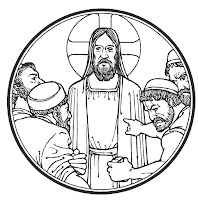

posture of public enemy, publicly teaching against the scribes and priests and Pharisees, in order to draw their murderous anger against Him.  

    Jesus came down and reclined at table, blessing the bread and wine of the Passover, transforming it to be His last will and testament, written in blood, effective forever, for the forgiveness of sins.  

    Later that night, Jesus knelt, in the garden, as He prayed:  Father, if it is possible, take this cup from me.  And yet not My will, but Thy will be done. 

     Then Jesus stood, arms bound, the posture of a prisoner, a criminal, as Roman soldiers mockingly knelt before Him.  Jesus assumed the posture of a staggering, doomed man, struggling under the weight of His own cross.  

     And finally, Jesus assumed the posture of love, stretching out His arms, nailed to that crossbar, loving us sinners to death, that He might share His life with us.  

   And He has.  And He does, right here, whenever we gather to hear Him, whenever we bring a sinner to the water of life, whenever we confess our sins and hear the Word of forgiveness, whenever we kneel at this altar, eating and drinking the life He has won for us.      

     And so whether in Church we kneel, or stand, or sit, whether we bow, or fall on our faces, we rejoice.  We rejoice because the posture of Jesus is the Gospel, the Good News that He stands for us, so we can stand without fear before the Father in glory.  

     Scripture teaches that Jesus will return in glory, and before Him every knee shall bow, of believers and unbelievers, friends and enemies, everyone in heaven and on earth and under the earth.  All will know and confess the Truth on that Day, for joy, or for unimaginable sorrow.  But fear not.  Jesus’ return is for your joy.  Before our crucified and risen Savior, with all believers who have been transformed by faith, we will kneel in wonder, bathed in His glory, as we enter into rejoicing, forever and ever, Amen.    

Sunday, January 23, 2022

Why do we fight for Life? Sermon for Sanctity of Human Life and the Third Sunday after Epiphany

Third Sunday after Epiphany
January 23rd, Year of Our + Lord 2022
Our Redeemer and Our Savior Lutheran Churches
Custer and Hill City, South Dakota
Why do we fight for life? 

2nd Kings 5:1-19a, Romans 1:8-17, Matthew 8:1-13

   Fight the good fight, with all your might.  So goes the hymn.  And for the last five decades, fighting the fight for life has animated American Christian Churches like perhaps no other concern.  And for good reason.  Millions of lives created by God have been destroyed by abortion, and millions of other souls have been burdened with guilt and sadness.  And the assault on the sanctity, the inherent value and holiness of human life, has not remained just an attack on the unborn.  Disabled people, old people, suffering people, and the family created by God to care for them, these all have suffered serious injury from the culture of death in which we live.   

   But perhaps there is hope on the horizon?  Is the fight over abortion, at least, maybe drawing to a close?  Could we be so blessed?  Through the bizarre and twisted path of American politics, seasoned observers are saying that there is a real chance that the Supreme Court of the United States could this year overturn the prior rulings handed down in Roe vs. Wade and Casey vs. Planned Parenthood.  Could it be that the unrestricted “right” to terminate a pregnancy at any point will no longer be the law of the land?  Wouldn’t that be a wonderful day?  Could that be the beginning of the end of the silent self-inflicted, slow-motion genocide that we Americans have been perpetrating on ourselves for the last five decades?    

    I don’t know how likely such a ruling is.  I’ll be glad if the Supreme Court overturns Roe and Casey.  In addition to our Christian concerns, protecting innocent life is simply a basic responsibility of good government.  And the legal foundation of the “right” to kill an unborn child has always been perverse and illogical.  But we need to be very clear that overturning Roe v. Wade will not end the fight.  Indeed, in many ways the work of pro-life Americans will become more urgent, perhaps even harder.  Overturning Roe and Casey would only return the authority to make law concerning abortion to the states.  Should these evil precedents fall, there will be a fierce reaction from those who, however misguidedly, honestly believe that a woman’s right to abort her pregnancy is sacrosanct. 

     We should welcome this fight, and recognize that with it would come a heightened need to care for many more souls caught in the crossfire.  Our “Speaking the Truth in Love” muscles will get a real workout.  But whether or not Roe and Casey are overturned, abortion will continue to be a problem, a plague, not because of bad laws, but because too many of our neighbors will want it.  And as I said before, the unborn are not our only neighbors who are threatened by the culture of death. 

   Once humanity takes upon itself the authority to determine which lives are worthy of protection and which are expendable, then any of us could become subject to rejection.  That is, to being declared undesirable, and then killed.  It could happen for being old, or the wrong race, or for having the wrong set of challenges, or the wrong politics.  

     It is fine and good to fight in the courts for the right to life.  But as the Church, as Christians, we need to remember that the real fight is in the hearts of mankind.  It is much better to help our pro-abortion and pro-euthanasia neighbors see the folly of their ideas and their ways than to simply defeat them before a judge or at the ballot box.  Because until Christ returns there will always another judge or another election, where progress for life can be reversed.  But if through the Gospel a new, for-life heart begins beating in someone formerly fooled by the lies of satan, well that is a wonderful thing.  But how do we do that?  How might we convert hearts from death to life? 

   We might start with Jesus.  And with our own hearts.  We might take a long look at exactly what our Lord, God’s Son, teaches and shows us about the value of human life.    For while we say we are for-life, are we really, biblically speaking, as much for-life as God is, and calls us to be? 

     For example, are we as for-life as the nameless Israelite girl enslaved in the household of Naaman, the Syrian general?  This little pro-life warrior sets quite the example.  How would you react, how would you behave, if at a tender age, maybe 8 or 9 years old, you were snatched from your family and home, carried off by soldiers, and then were put to work in the household of the commander of the army who had enslaved you? 

   Well, of course you would be filled with concern for that general, Naaman, because despite his greatness, he was plagued by leprosy, his skin disfigured and gross, a painful disease that caused men of less importance to be shunned and separated from society.  Surely we, like this little Israelite girl, would have compassion for Naaman’s suffering, and we would even suggest a solution to our mistress, Naaman’s wife, the woman who day to day enforced our slavery.  Would we?  If we knew of a sure cure to a disease that plagued the man who enslaved us, would we share this good news with him? 

     The little girl did.  Where did this act of compassion, some might say foolishness, but I will say compassion, where did this selfless, ‘love-your-enemy’ action come from?  Well, it has to be that this girl believed what she had been taught from Moses:  You are to love the LORD your God with all your heart, soul and strength, and you are to love your neighbor as yourself.  This young Israelite was a believer, who knew how the LORD loved her.  She lived in that love, confident of God’s care, regardless of her circumstances, a beautiful example of childlike faith.  And in her new circumstances, Naaman was her neighbor, so she quite naturally loved Naaman and sought his good. 

   Naturally, that is according to faith in the LORD.  And through her good news proclamation, through her act of love toward a man who was objectively her enemy, the LORD worked.  Through His faithful child, the LORD drew another dying sinner to the cleansing waters of His saving love.    

     By word and deed, Jesus made multiple references and allusions to Naaman during His earthly ministry.  Sometimes our Lord was explicit, throwing in the faces of His Jewish interlocutors the inconvenient fact that the LORD chose to heal the leprosy of a Syrian, a gentile sinner and notorious enemy of the Jews.  At other times the Lord’s reference is more subtle, like in our Gospel reading today.  Jesus cleanses an unidentified leper, even willing to touch this unclean man as He cleansed him from his disease, breaking the rules and taboo handed down by Moses.  According to the Law, Jesus, by touching the leper, was taking this man’s disease upon Himself.  Which is precisely what Jesus came to do.  By this, our Lord set a suffering soul free, while at the same time showing that someone greater than Moses had arrived upon the scene. 

   Next, Jesus receives the plea of a Centurion, a Roman military commander, an oppressor of Israel, who wasn’t asking for a miracle for himself, but rather for his servant.  This military occupier saw a neighbor in his servant, his bond slave.  The centurion loved this servant, who very well may have been a Jew, we don’t know.  Perhaps the Centurion heard of Jesus through the servant.  Regardless, after healing a leper, Jesus responds to the faithful plea of this enemy, this military oppressor of God’s people, and heals his servant with a word, from a distance, without ever visiting him. 

   You and I need to have the connection to Naaman pointed out to us, but faithful Jews of Jesus’ day would likely have understood it without a problem.  But just in case anyone missed his point, Jesus, after extolling the faith of this Roman commander, declares how many non-Israelites, how many gentiles from east and from west will sit at table and feast with Abraham, Isaac and Jacob in the kingdom of heaven, while sons of the kingdom are cast out.  And Jesus made it clear that in Himself, the LORD was now present in Israel as never before, present in the Man Jesus, Son of Mary, and Son of God. 

   And so we are reminded that we are for-life first, last and always, because of the Gospel.  By God’s grace and working, we are not ashamed of the gospel, for it is the power of God for salvation to everyone who believes, to the Jew first and also to the Greek. 17 For in the Gospel, the righteousness of God is revealed from faith for faith, as it is written, “The righteous shall live by faith.”   Our life in Christ, our new life, both spiritual and physical, the promise of victory over death, by the forgiveness of our sins earned by Jesus on the Cross, this is what makes us pro-life, “for life,” and also lovers of our neighbors, including our enemies. 

   Why?  Because, while we were still His enemies, rebellious sinners destined for hell, Jesus loved us.  And He loved us perfectly, laying down His sinless, holy life, to save ours, washing away our death and making us alive, together with Him. 

     Living out the truth that Christ and His Church are naturally for life will get us in trouble.  Jesus’ love for human life is what led to His death.  In His resurrection victory we find our joy and our courage to love all life.  Paradoxically, speaking out for life requires us to speak against people when their actions seek and glorify death.  But we do so for the sake of the Gospel, for the sake of being able to arrive at the position of that little Israelite girl who loved her enemy Naaman, and was God’s instrument in changing his heart, cleansing his body and saving his eternal soul.   

   Let’s switch gears, go conversational, and talk about this crucial topic just a bit. 

Distribute and teach the insert.

   I want to finish with a strong Gospel declaration.  Talking about being for-life is hard, because it makes us also consider death.  So we need to finish on Good News.    

   But I must first give a warning:  Not every faithful Israelite who sought the good of her neighbor was gladly heard like Naaman’s little slave preacher.  Speaking the truth of the Gospel to unbelievers will often, maybe usually, attract rejection, not acceptance.  We do it because we have been loved and know that there is enough love of Christ for all people.  But until the Holy Spirit creates true faith in the heart, the Gospel is offensive.  It would be ministerial malpractice for me not to clearly explain this truth to you. 

   Still, all the joy is found in the Gospel and the “for life” calling it brings.  So, despite the difficulties that can come, I pray the Holy Spirit will give opportunity and courage to each of us to be and act “For Life”, again and again, even when we have been rejected. 

    Because this who we are, baptized believers, the truly alive, members of Christ’s Body, the Church, lambs under His eternal care.  We are for life because God has made us alive in Christ Jesus.  Nothing can separate you from Him, nothing can defeat the victory He has won for you, nothing can destroy the eternal life into which He has baptized you and taught you and fed you. 

   Jesus has chosen you, for life.  To Him be the glory, for this precious Gospel and this wonderful, undeserved life we have received,

In the Name of the Father, and of the Son, and of the Holy Spirit, forever and ever, Amen.  

Sunday, January 16, 2022

The Very Best Wine - Sermon for the 2nd Sunday after the Epiphany

The Second Sunday after Epiphany                             
January 16, A+D 2022
Our Savior’s and Our Redeemer Lutheran Churches
Hill City and Custer, South Dakota
The Very Best Wine

Jesus wants to be your sommelier, and serve you the very best wine.    

Our texts for this Second Sunday after Epiphany offer us a lot of options for preaching.  Last year on this Sunday, in my first sermon as your pastor, I focused on marriage, both the earthly institution that is in such desperate need of support, and the heavenly marriage between Christ and you, His Church. 

   On the third day.  Why did John begin this account of the wedding in Cana with “on the third day?”  The third day since when?  Or perhaps John wants to put resurrection day thoughts in our heads? 

   At this wedding in Cana, we hear of six stone jars filled with water for rites of purification, more than enough reason to dive deep into the wonderful gift of Holy Baptism.  In this lifetime we will never reach the bottom of this well of blessing.   

   Or we could simply look at one of the basic points of the season after Epiphany, as we unwrap the Gift of Christmas and come to see who this Jesus is, true God and true man.  Prophet, Priest and King.  God in the flesh, come to save us. 

   But I think today I’d rather preach about good wine.  Because Jesus wants to give you the very best wine.  He wants to be your eternal sommelier, your divine wine steward, serving you with the best wine, indeed saving the very best for last, and forever and ever, Amen. 

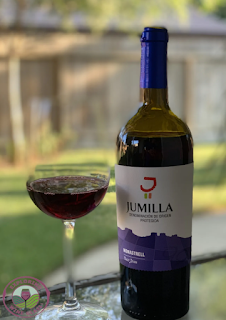
   So, to start with, do you like wine?  If so, what kind?  I have grown to prefer a bold, dry red wine, made from Cabernet, Merlot or Malbec grapes, or if I’m really lucky, from Monastrell grapes from the Jumilla region of Spain.  Spicy and plummy and complex, with hints of...  I could go on. 

   Of course, as a resident of Hill City, where strangely we talk about wine from the prairie, I’m made aware that many folks like light, sweeter fruit wines.  Not my favorite, but to each his own.         

   Before we go on, please know that I don’t make light of the fact that wine, along with other types of alcohol, can lead us to very destructive places.  One of the saddest things about our fallen, sinful human nature is the way we can ruin and misuse anything.  Delicious food, the gift of being a man or a woman, the ability to invent new and powerful technologies, we sinners can and do take all of these good gifts and pervert them into hurtful, destructive, sinful activities. 

   Wine is no different.  A good wine, according to prophet Amos, in agreement with the rest of the Bible, is a great blessing, bringing joy to the heart.  However, by overusing, abusing or becoming addicted to alcohol, we are all too capable of ruining lives, our own, and the lives of others.  I would be surprised if there is any person within the sound of my voice who has not been negatively affected by the misuse of strong drinks.  Wine is a good gift, for those who like it, and if enjoyed in moderation.  But we owe it to each other and all our neighbors to be clear eyed about the ways we can and do misuse it. 

   We need to repent of these sins, like all the rest.  We need to confess our sins, lest they grow and get between us and Christ.  If alcohol, or anything else, is ruining your life, please seek help.  Don’t try to hide it.  Don’t try to go it alone; that won’t work out well.  We are all in this life together, none of us is strong enough to make it alone.  Talk to me.  Talk to a friend.  Find someone to help you confess, to God and to yourself, that you need help.  It’s a frightening road, I know.  But Christ will walk it with you, and your forgiving Savior can and will bring you through.   

   We are sadly capable of abusing wine.  Still, Jesus does want to be your sommelier, your wine steward.  He wants to give you the very best wine.  And as part of His path to reach this goal, He even performed a remarkable miracle, turning something around 150 gallons of water into excellent wine at the wedding in Cana. 

   The surface reason Jesus did this was simply to help a newlywed couple, to spare them a bit of embarrassment at their wedding reception.  The wine had run out.  Seems too minor a problem to bother the Son of God.  But, as the choir (at Our Redeemer will sing this morning) (will sing in a few minutes), “Our God’s a God of Joy and Mirth.”  The Lord loves a good celebration.  Heaven will be a joyful, exciting, wonderful place.  Imagine the spontaneous smiles and laughter that will fill us when all pain, every tear, and all our guilt and shame are forever taken away. 

   Life with God in Heaven is going to be wonderful beyond our imagination.  At the same time, Jesus is glad to help us find moments of joy and happiness today.  But Jesus does save the best for last, because the first order of business for the Son of Mary is not to give temporary joy, but rather eternal peace, happiness and celebration.  

    To give sinners like you and me eternal joy, Jesus had to give us even better wine than the marvelous vintage that shocked the master of the wedding feast in Cana.  For even the very best wine, the very best earthly gifts, are depressingly short-lived.  An excellent bottle of wine is still only 5 glasses.  And whether you open it right away or save it sealed in your cellar for years, it will not stay excellent forever.  With our refrigerators we can make food last longer, but still, a prime rib or a coconut cream pie has to be eaten soon, within a few days, before it goes bad.  Without refrigeration, we need to eat it right away.  Decay, rot, and spoilage are unavoidable in this world, because our sin has ruined everything. 


   One reason wine was so important in the ancient world was that a whole host of microbes were turned destructive at the moment of humanity’s fall into sin.  Because of these now harmful microbes, most water in the world is nearly undrinkable.  There is no life without water, but for most of human history, finding clean water has been a real struggle.  So wine and beer were not just indulgences, they were staples in the diet.  Because the alcohol in the wine or beer killed some microbes, and so made getting sufficient hydration a bit safer.  In many and various ways, the whole creation groans under the burden of our fallen nature.

    During the Epiphany season we unwrap the gift of Christmas, by reflecting on many things Jesus did to reveal Who He is.  But Epiphany is only prelude to the main event.  The miracle worker at Cana went on to heal many sick people, cast out demons, cleanse lepers, and raise the dead.  But Jesus eventually stopped doing these minor miracles.  Because they did not get at the real issue.  Turning water into wine, or giving sight to the blind, or new life to a twelve-year-old girl were wonderful gifts.  But in all of these signs, Jesus was only treating symptoms of the real disease that He had come to cure.

    And to cure our real disease, to give us access to the very best wine that God the Father has reserved for the Heavenly Wedding Feast, this would require a much more radical intervention.  To serve us the best wine, Jesus would have to open the vessel of His own body.  Because the root cause of the rot and decay in this world is not just a physical issue, it is a moral one.  The real issue is our sin.  So, to restore the Creation, all our wrongs had to be put right.  And so the Miracle Worker, in order to become the eternal Wine Steward to humanity, would go to the Cross. 

   There on Golgotha, Jesus absorbed from His Father the just punishment our sins deserve.  Jesus gave His all, loving us to death.  And then, giving up His Spirit, from His pierced side poured forth water and blood.  And these three bear witness, the Spirit, the water and the blood.

   The Spirit, Who declares to you that Jesus has done it all, for you.  All the good.  And all the suffering.  Jesus has done it all. a

   The water, which washed you clean as God the Father declared you His beloved child through Holy Baptism.

   The blood of Christ, in with and under the wine, the New Testament in the
Blood of Jesus.
  Indeed, while Mogen David Concord grape wine is not considered by many to be very fine, there is truly no finer wine in all the creation than that which is served at this altar, and at Christian altars all around the world.  For here, in with and under the whatever grape wine we use, Christ Jesus serves you with the medicine of immortality, shed for you, for the forgiveness of all your sins. 

   The birthright of every newborn Christian is to dine with God, to break bread and drink the very best wine, that washes away sins, gives us a good conscience, and makes us worthy of God’s eternal banquet.  There, finally, with angels and archangels and all the company of heaven visible to our own eyes, we will feast with God, face to face, the very best wine saved for last, and forever and ever.   Until that wonderful day, God grant that we keep listening to the voice of the Spirit, speaking to us about Jesus, who comes to us through the Water and the Blood.

In the Name of the Father, and of the + Son, and of the Holy Spirit, Amen.  

Sunday, January 2, 2022

Identity - Sermon for the 2nd Sunday after Christmas

2nd Sunday after Christmas
January 2nd, Year of Our + Lord 2022
Our Redeemer and Our Savior’s Lutheran Churches
Custer and Hill City, SD
Identity

   Who am I?  Who am I, really and truly?  Do I want to be me?  And why are these things happening to me?  Today there is a pandemic of identity crises.  As the world goes mad, traditional institutions like nation, religion and family somehow fail to help people know who they are.  Not finding themselves in their real community, countless souls search the web, seeking a virtual reality to connect with.  Still, while this identity crisis is especially severe today, it is not new.      

   Jacob’s identity crisis is neatly described by his two names, for Jacob is also Israel.  Jacob the grasper, the schemer, who weasels his way into his brother’s inheritance and blessing, is nevertheless chosen by God as the third patriarch in the line of the savior


Messiah, the promised Christ.  Through the years, God visits Jacob repeatedly, reminding him of his greater identity.  Visits which include an all night long wrestling match with God, who appeared in the form of a man.  As the dawn broke, with Jacob refusing to give up his grip on the Man, God gives Jacob the new name that his descendants would all share: Israel, he who struggles with God and men, and prevails, just by hanging on. 

    Now, in our Old Testament reading, Jacob faces a late-in-life tumult:  he is called to pick up everything and move to Egypt, trusting the remarkable news that his favorite son Joseph, given up for dead long ago, is alive, and is ruling over all Egypt, in Pharoah’s stead.  Can I really trust this promise?  Jacob’s internal doubts lead the believer God had made him to be to seek the Lord in worship.  Jacob hangs on, and God responds with a definite answer.  Yes, Jacob, go.  Go down to Egypt, without fear, for I am still with you, wherever you go.   


 Almost 19 centuries later, the second famous Joseph, Joseph the husband of Mary and Guardian of the child Jesus, was probably wondering, like his ancestor Jacob.  A faithful Israelite, who received visions from God like Jacob, and like the original Joseph, Mary’s husband did the right thing.  But don’t you think Joseph may have had some questions?  Why had he, a nobody carpenter from the northern backwaters, been pressed into repeating Israel’s journey to Egypt, although under much more dangerous conditions?  “Who am I, O Lord, that you have called me to this?”   

   The Wise Men at least don’t seem to be confused.  They act on the new identity that comes from trusting in and worshiping the King Jesus.  King, they now realize, not only of the Jews, but of all Nations, the very King of Heaven, come down to earth.  So, warned by God, again communicating through a dream, they are bold to disobey Herod, and depart by another route to avoid the evil ruler of Jerusalem, as they carry the news of the Christ Child to their home in the East.   

   King Herod, ruling in Jerusalem, should have had a clear picture of who he was, don’t you think?  Everybody knows him.  He’s a powerful and widely feared man.  He should be confident of his identity.  But it seems not.  Word of an unknown infant king rocks his world.  Perhaps his insecurity came from the fact that he was not really a king in the proper sense.   He ruled, but under orders, governing over the Jews in the name and by the permission of the Roman Emperor.  Perhaps Herod’s rise to power was the result of a life of overcompensating for his insecurities.  Regardless, for some reason, when Herod discovers the Wise Men have tricked him, he flies into a rage and panics.  He reveals his selfish, murderous, hardened heart by ordering the death of all baby boys below two years of age, in Bethlehem and in the whole region, a mad attempt to protect his ego and his pretend throne. 

   I wonder what life was like in Bethlehem in those two years or so since Jesus’ birth.  How well known did the message of the angels and the shepherds make the Holy Family?  And what was the village gossip when the Magi arrived, bearing rich gifts of gold, frankincense and myrrh, and falling down to worship Mary’s toddler Son?  The faithful in Bethlehem were drawn into the great drama of God’s salvation, in a frightening and terrible way.  Herod’s brutality made the first New Testament martyrs, the first of God’s people to be persecuted and killed for the sake of the Savior, born for us.

    The first to be persecuted for the sake of the Christ, but definitely not the last.  The Apostle Peter knows the danger of persecution, from his own failure to confess the truth about his connection to Christ, on the night Jesus was betrayed.  Around the fire in the High Priest’s courtyard, Peter learned that just the threat of persecution can make sinners deny their identity.  Later, his denial of Jesus forgiven, and his call as Apostle restored by the resurrected Christ, Peter went on to face much more persecution, but without denying His Lord. 

     Peter knows of what he speaks.  And so his letter to persecuted Christians is chock full of identity reminders: “If you are insulted for the name of Christ, you are blessed, because the Spirit of glory and of God rests upon you.  15 But let none of you suffer as a murderer or a thief or an evildoer or as a meddler. 16 Yet if anyone suffers as a Christian, let him not be ashamed, but let him glorify God in that name.”  

   Glorify God for the privilege of suffering for being a Christian.  Yes, Peter is bold to tell those first century persecuted Christians, and us, that we should rejoice if we are persecuted for the Name of Christ. 

     The Apostle Paul says the same, and they are both echoing Jesus Himself, for example in John 15, where Jesus warns the future Apostles: “If the world hates you, you know that it has hated Me before it hated you.”  “Rejoice and be glad,” says Jesus, “for your reward is great in heaven.  For so they persecuted the prophets who were before you.” (Matthew 5:12)

   Persecution flows from the nature of God’s plan of salvation.  All the way back to Jacob and beyond, back to the Garden, God’s intent has been to redeem a people in His own good Name.  To win condemned, dying sinners back from the power of sin and satan, by calling them to a new identity, the identity of sons and daughters, beloved children of God.  Jesus came to bind the strong man satan and free the prisoners he held in sin, in order to make them holy members of God’s family.  So it cannot surprise us that satan hates and wants to persecute all who are called by the Name of Jesus.  He thought he had us, but now we are free in Christ.  So satan is bitter. 

     Sadly, the world, knowingly or unknowingly under diabolic influence, actively serves as satan’s instrument for stalking the Church, looking for believers to oppress.  So we should not be surprised to suffer as Christians. 

     But when suffering comes we are surprised, and appalled.  Frightened.  Someone you consider a friend mocks God to your face.  Your favorite comedian belittles your faith.  The coach of your child’s sports team pressures you to choose a game over attending church.  The in-group at work or school entertains themselves with pornography and lewd jokes.  And you are called, again and again, to take a stand for who you are in Christ. 

    So, who am I really?  Do I really want to be who I’ve been called to be?  Where will I find the confidence to confess Jesus, and not deny Him?  How can I muster the peaceful strength required to rejoice in suffering for the Name? 


    Such confidence and peace are found in the only character in our readings today who was never confused about His identity.  It is a mystery beyond our grasp that God messed a diaper, and nursed, and grew up, learning to walk and talk and laugh and play.  We rightly marvel in the love demonstrated when the glorious Son of the Father came down from His throne, to become our brother.  At the same time, we should never forget that all the while He was growing through every stage of human development, Jesus Christ was also the eternal and almighty God. 

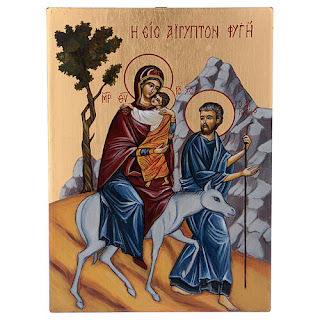
     Jesus, the very Wisdom of God, the Word made flesh, always knew who He was.  He allowed Himself to be protected and cared for by His own creatures.  The One who gave the Law to Moses honored His adoptive father and His mother.  He lay in the manger and fled to Egypt, appearing to be just another unknowing refugee child, carried along by the grown-ups, unaware of the passions and hatred that were behind His flight.  But He knew who He was.  God the eternal Son always knew His identity, and His Mission, what He was here to do. 

     He was and is Emmanuel, God with us, the Messiah, the Christ, the Anointed Savior of Israel.  Jesus, the LORD who saves, the Bright Morning Star that enlightens our darkness and dispels our sin.  He is the Bread come down from heaven to feed the faithful unto eternal life.  The Prince of Peace, who sets us free to live at peace with each other, because He has made peace for us with God.  The Wonderful Counselor who gives us His Spirit to teach and guide us on the Way of Salvation.  The Seed of the Woman, come to crush the serpent’s head.  The Promise of Abraham, come to bless all the families of the earth.  The Star of Jacob and the Scepter of Israel, the eternal Son of David, who rules to bless and provide for His people, unto all eternity. 

     In the many titles of Jesus, the Good News that God is merciful and loving, despite our sinfulness, is fully revealed.  The Christ Child, in the mystery of the Holy Trinity, is the God of Abraham, Isaac and Jacob, who formed a great nation for Himself from unlikely beginnings, led them into Egypt, and then out again.  The God who, despite Israel’s idolatry and rebellion, remained faithful to them and to His own Name, until the fullness of time.  Jesus came not to be served, but to serve, to be the Suffering Servant, on whom all our sins were laid.  By His stripes, we are healed.   

    This same Jesus Christ has shared His identity with you, calling you Christian by the washing of Water with the Word, calling you out of darkness, and into His marvelous light.  In Him you have redemption from all oppression and suffering, by the forgiveness of your sins.  In this name, Christian, you will, for a time, be subject to trials of various kinds.  But you do want this Name, this identity.  For there is no other Name given among men by which we must be saved, Jesus Christ, our justification, our holiness, our wisdom, our life, forever and ever. 

    Rejoice in the Name you have been given.  Rejoice, even though from time to time you may suffer briefly.  For the sufferings of this present time do not compare to the joy that is to be revealed.  You can hang on, because all the while, Christ is with you, hanging on to you, just as He was with Jacob, and Joseph.   Just as He was there to comfort the mothers of Bethlehem, and welcome their martyr children into heavenly peace.  Christ is with you, to pick you up when you stumble, forgive you when you fail, and to bring you through the journey of this earthly life, safe in His loving care. 

In the Name of the Father, and of the Son, and of the Holy Spirit, Amen.